

The client’s challenge
Before the system was implemented, most of the Judicial Inspection’s work relied on paper-based processes, supported by records kept in Excel. In practice, this way of working created several bottlenecks that impacted day-to-day operations.
Reporting was often time-consuming and difficult. Data was either incomplete or hard to correlate, making it challenging to get a clear, accurate picture when needed. The same information had to be entered into multiple registers. This not only increased the workload but also introduced a real risk of inconsistencies when updates were not applied uniformly.
The lack of real-time data also affected decision-making speed. There was limited visibility into how cases were distributed across inspectors or which ones were approaching deadlines, leading to inevitable delays.
Workload distribution was difficult to balance without a centralized system, and manually checking similar cases across multiple registers often resulted in duplicated efforts.
Access to case information was not always quick or straightforward. Finding the necessary data frequently meant time lost and navigating cumbersome processes.
In this context, the objective of the ECRIS IJ system was clear: to simplify the way teams work, eliminate operational bottlenecks, and bring greater clarity, speed, and accuracy to the management of Judicial Inspection cases & workflows.
Process & Steps
- Project management and end-to-end coordination;
- Business analysis and definition of functional and technical requirements;
- System architecture (software, hardware, and infrastructure);
- Application and database development;
- Infrastructure implementation and system integration;
- Testing;
- User training;
- Go-live and post-implementation support.
Technologies


Key features
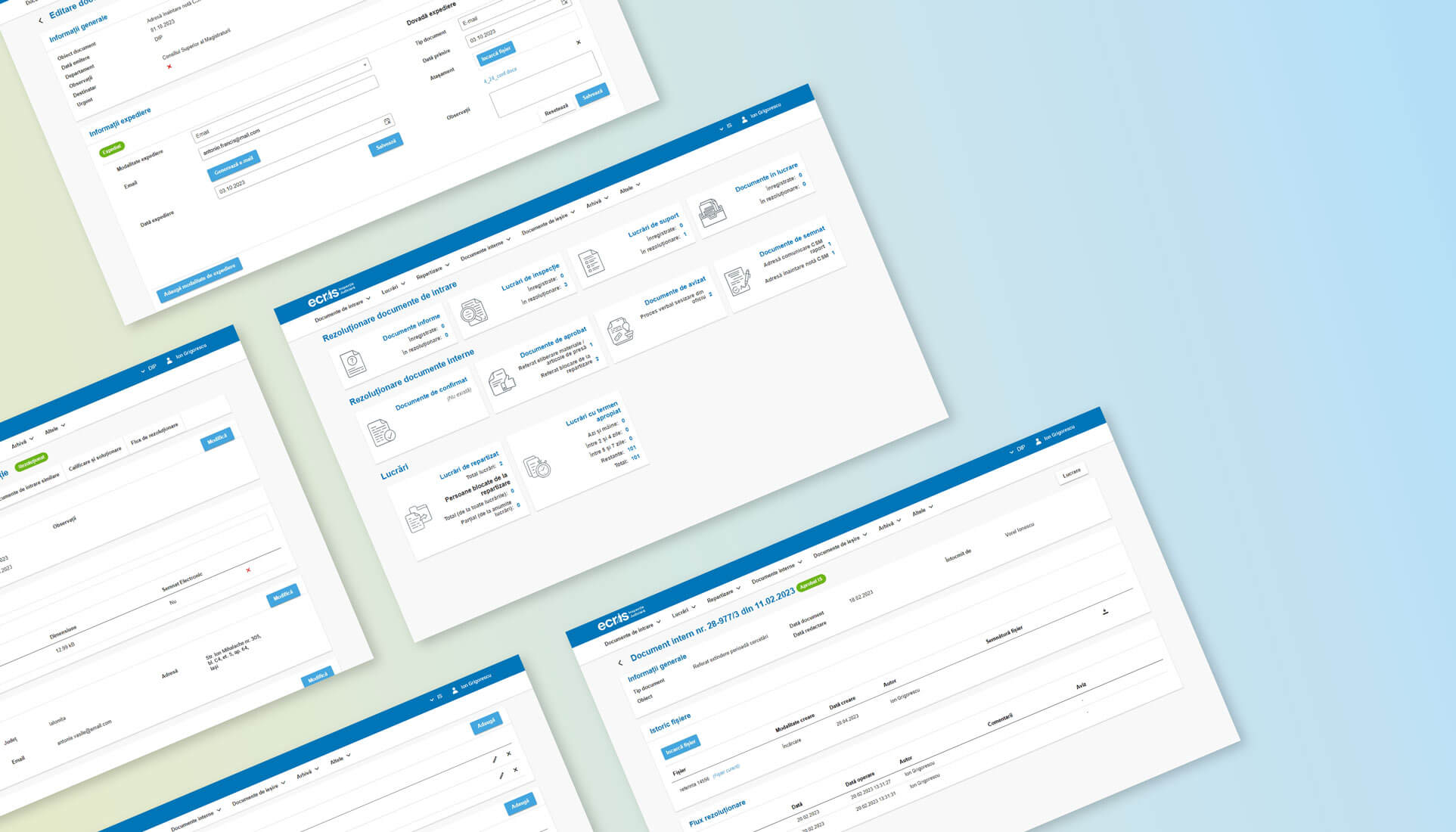
The ECRIS IJ application was designed to address the operational challenges of the Judicial Inspection by providing a complete digital solution tailored to the institution’s needs.

Streamlined and controlled document registration, featuring clearly separated data entry areas and
assisted correlation with related documents and cases.
Documents are managed using fully customizable workflows, enabling precise alignment with
established operational rules, roles and approval processes.
The system automatically generates cases from incoming documents, reducing repetitive manual input while ensuring consistency and data integrity from the outset.
Cases can be assigned automatically or manually, ensuring an even distribution of workload across inspectors.
The system allows users to monitor status, deadlines, and progress at any stage, supporting timely and informed decision-making.
Standardized document generation using configurable placeholders to ensure consistency, accuracy and rapid production of oficial documents.
Data can be easily turned into clear reports and meaningful insights to support decision-making.
Documents are archived in compliance with legal requirements and can be quickly retrieved when needed.
Access to information is governed by role-based controls, ensuring that sensitive data is protected in
accordance with authorization levels.
A comprehensive audit trail capturing every action and change in the system, ensuring full
accountability, traceability and compliance with institutional requirements.

Project impact
Following implementation, the system brought a tangible change in how cases and related workflows are managed within the Judicial Inspection.
First, processes became noticeably faster. The time required to manage cases was reduced, and access to information no longer depends on manual searches or consolidating data from multiple sources.
At the same time, data quality improved significantly. Every action is clearly traceable, providing greater control and predictability in day-to-day operations. Information security was also strengthened, with the system offering a high level of protection for the institution’s sensitive data.
User feedback was another key indicator of success. The application is perceived as easy to use, stable, and reliable, factors that supported rapid adoption across the organization.
- it integrates with existing IT systems using standardized data formats;
- it enables fully digital document management, including fast generation and retrieval;
- it is ready for electronic signature implementation;
- it provides secure access to documents for all stakeholders, from inspectors to other relevant institutions.
Testimonial

Essensys’s solution reduced processing times, improved accuracy and data security, and received positive feedback from end users. The team was very professional, proactive, communicative, and responsive to feedback and changes.
Project Manager, Judicial Inspection

Conclusion
The ECRIS-IJ project went beyond building an application, it delivered an integrated IT system designed to support a critical domain where accuracy, traceability, and data security are essential.
Through an end-to-end approach, from analysis and architecture to implementation and ongoing support, the solution brought structure, consistency, and predictability to the way the Judicial Inspection manages its activities.
The result is a robust and scalable platform that not only improves current processes but also provides a strong foundation for future growth, whether through integration with other systems, expanding functionality, or adopting new technologies such as electronic signatures.